Secure your cookies

In light of the publicity created by Firesheep, HTTPS Everywhere has been updated to force websites to activate a secure flag in cookies used to authenticate their users.
I finally tested Firesheep. It is painfully easy to use for hijacking sessions. Here I start Firesheep on a Windows machine (via RDP) and I log into Facebook on a Ubuntu system. As seen in the screenshot, Firesheep quickly captures the cookie of that session and permits easy access to the active account.

Blacksheep

Security vendor, Zscaler, unleashes a tool named Blacksheep to warn users of the presence of a machine running Firesheep. It doesn't mitigate session hijacking but sounds an alarm to alert of a malicious party in close proximity.

Firesheep

Session hijacking is nothing new with early tools such as Ferret supporting this attack. This Firefox extension, Firesheep, has simplied the attack.
I can't wait for the Linux version to be released so that I can play with it. Ways of avoiding becoming a victim of session hijacking are:
  1. Using encrypted wireless networks.
  2. Using a VPN tunnel over insecure wireless networks.
  3. Use full HTTPS sessions. HTTPS Everywhere is one tool that automates the use of HTTPS for popular websites like Facebook.
  4. Be wary of links sent via email or instant messaging.

Bruteforcing analysed

The concept behind the article "Learning from bruteforcers" in issue 27 of (IN)SECURE Magazine is simple but I appreciate the author’s thorough analysis and trending.
Easily one of the most interesting articles that I have read in a long time.

"Prey: A new hope"

A combination of inspiration from reading about the tool, Prey, and an email from Hakin9 mag's editor prompted me to write a new article.
An excerpt from my new article.
"Misplaced your laptop or had it stolen? You are not alone. Dell and the
Ponemon Institute collaborated on a study with 106 United States airports
as well as over 800 business travelers to ascertain the frequency with which
laptops are lost in airports."

Prey

Ever worried about your laptop getting lost? There's a software called "Prey" that can ease your fears. It is a utility that lets you know where your laptop is and can be installed on Windows, Linux and Mac OS X.
It is easy to setup. Register with the Prey website then enter the API and device key information into the configuration window to start the agent.

XSS and SQL injection

These attacks are not new but yet are still very effective against web applications. Here is an article that discusses how to test for such vulnerabilities and how to mitigate them.

Tabnabbing

A new type of phishing attack conceptualised by this security researcher. Rather than try to rehash his explanation, it is best to read his article.

HTTPS Everywhere

Most websites support HTTPS but do not switch users to the more secure protocol when they visit their sites. The EFF and Tor project have collaborated to release a Firefox addon to automatically redirect users' sessions to HTTPS.
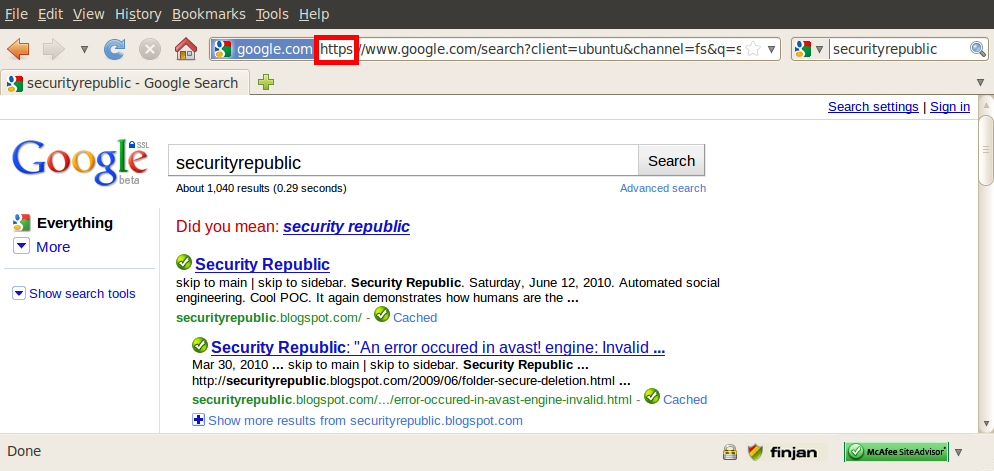
Here I demonstrate a Google search prior to installing the plug-in. My search is trasmitted over the Internet in cleartext. After installing the tool, my Google search is automatically secured over HTTPS. The tool has a default list of websites supported but offers the flexibility of adding your own URLs to be managed by it.

iPhone pin bypass

Another reason to love "Lucid Lynx". Security researcher discovers that Ubuntu 10.04 permits users to access data on iPhone without needing to know the security pin. Too bad I do not own an iPhone to test this myself.

Automated social engineering

Cool POC. It again demonstrates how humans are the weakest link in security. You can educate people and display warnings but victims will still click on malicious links.

Ubuntu maintenance script

 Wrote a simple script for keeping packages and snaps updated in Ubuntu.