The concept behind the article "Learning from bruteforcers" in issue 27 of (IN)SECURE Magazine is simple but I appreciate the author’s thorough analysis and trending.
Easily one of the most interesting articles that I have read in a long time.

"Prey: A new hope"
A combination of inspiration from reading about the tool, Prey, and an email from Hakin9 mag's editor prompted me to write a new article.
An excerpt from my new article.
"Misplaced your laptop or had it stolen? You are not alone. Dell and the
Ponemon Institute collaborated on a study with 106 United States airports
as well as over 800 business travelers to ascertain the frequency with which
laptops are lost in airports."
An excerpt from my new article.
"Misplaced your laptop or had it stolen? You are not alone. Dell and the
Ponemon Institute collaborated on a study with 106 United States airports
as well as over 800 business travelers to ascertain the frequency with which
laptops are lost in airports."
Prey
 Ever worried about your laptop getting lost? There's a software called "Prey" that can ease your fears. It is a utility that lets you know where your laptop is and can be installed on Windows, Linux and Mac OS X.
It is easy to setup. Register with the Prey website then enter the API and device key information into the configuration window to start the agent.
XSS and SQL injection
These attacks are not new but yet are still very effective against web applications. Here is an article that discusses how to test for such vulnerabilities and how to mitigate them.
Tabnabbing
HTTPS Everywhere
Most websites support HTTPS but do not switch users to the more secure protocol when they visit their sites. The EFF and Tor project have collaborated to release a Firefox addon to automatically redirect users' sessions to HTTPS.
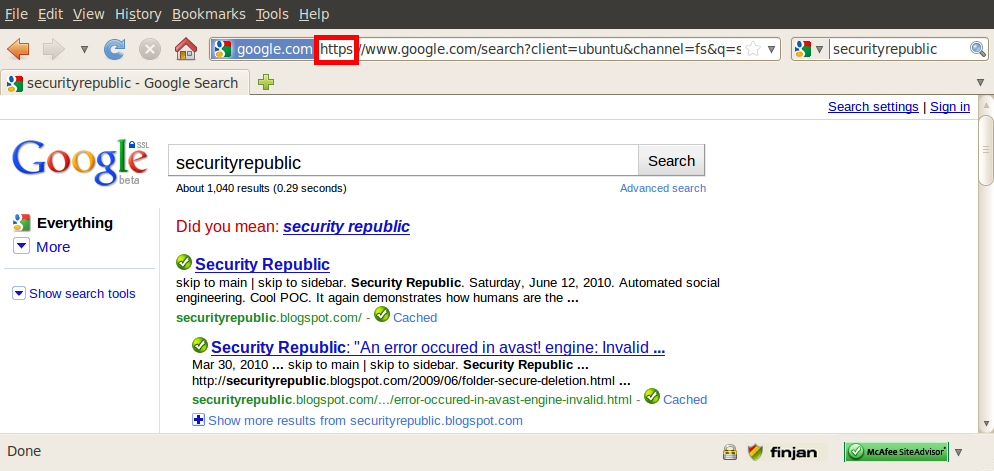
Here I demonstrate a Google search prior to installing the plug-in. My search is trasmitted over the Internet in cleartext. After installing the tool, my Google search is automatically secured over HTTPS. The tool has a default list of websites supported but offers the flexibility of adding your own URLs to be managed by it.


Here I demonstrate a Google search prior to installing the plug-in. My search is trasmitted over the Internet in cleartext. After installing the tool, my Google search is automatically secured over HTTPS. The tool has a default list of websites supported but offers the flexibility of adding your own URLs to be managed by it.



iPhone pin bypass
Another reason to love "Lucid Lynx". Security researcher discovers that Ubuntu 10.04 permits users to access data on iPhone without needing to know the security pin. Too bad I do not own an iPhone to test this myself.
Automated social engineering
Cool POC. It again demonstrates how humans are the weakest link in security. You can educate people and display warnings but victims will still click on malicious links.
Browser fingerprinting
 Security researchers discover that majority of users can be uniquely identified by fingerprinting their browser. Apparently... the way our browser is set up can give us away. They host a website for you to test this.
Jarlsberg
Google has hosted a vulnerable application called "Jarlsberg" to teach interested parties about how to attack and defend applications. Haven't given it a go so I can't comment (yet) how to compares with WebGoat.
Embedded files
Lumension vendor visited the office. During their presentation, they mentioned whitelisting and blacklisting files to tackle data leakage. I inquired if the Lumension agent was able to detect blacklisted files (eg. executables, audio) embedded inside whitelisted files (Office documents). The vendor couldn't answer my question.
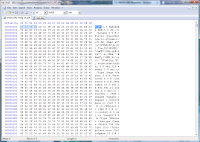
That piqued my curiosity. I embedded the same PDF file inside a Word doc twice by manually copying and pasting it into the doc as well as inserting it as an object. Firing up my trusty Hex editor, I was only able to find the magic bytes (ie. ASCII "%PDF" or hex values "25 50 44 46") for the PDF file that was embedded using the insert object method. I was not able to detect the embedded PDF file that was manually copied.


This is an interesting loophole from a hacker and forensics perspective.
That piqued my curiosity. I embedded the same PDF file inside a Word doc twice by manually copying and pasting it into the doc as well as inserting it as an object. Firing up my trusty Hex editor, I was only able to find the magic bytes (ie. ASCII "%PDF" or hex values "25 50 44 46") for the PDF file that was embedded using the insert object method. I was not able to detect the embedded PDF file that was manually copied.


This is an interesting loophole from a hacker and forensics perspective.
Subscribe to:
Posts (Atom)
-
This annoying message popped up after I ran the update in avast! in Ubuntu yesterday. avast! crashes every time I attempt to launch it after...
-
 I decided to install a digital certificate for my Gmail account. This is simple and free to set up. Apply for a free certificate from Comod...