Tabnabbing
A new type of phishing attack conceptualised by this security researcher. Rather than try to rehash his explanation, it is best to read his article.

HTTPS Everywhere
Most websites support HTTPS but do not switch users to the more secure protocol when they visit their sites. The EFF and Tor project have collaborated to release a Firefox addon to automatically redirect users' sessions to HTTPS.
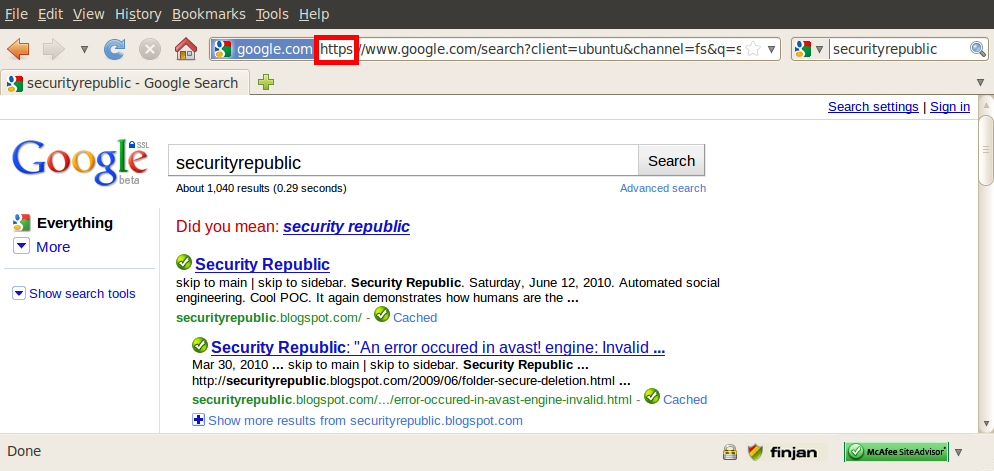
Here I demonstrate a Google search prior to installing the plug-in. My search is trasmitted over the Internet in cleartext. After installing the tool, my Google search is automatically secured over HTTPS. The tool has a default list of websites supported but offers the flexibility of adding your own URLs to be managed by it.


Here I demonstrate a Google search prior to installing the plug-in. My search is trasmitted over the Internet in cleartext. After installing the tool, my Google search is automatically secured over HTTPS. The tool has a default list of websites supported but offers the flexibility of adding your own URLs to be managed by it.



iPhone pin bypass
Another reason to love "Lucid Lynx". Security researcher discovers that Ubuntu 10.04 permits users to access data on iPhone without needing to know the security pin. Too bad I do not own an iPhone to test this myself.
Automated social engineering
Cool POC. It again demonstrates how humans are the weakest link in security. You can educate people and display warnings but victims will still click on malicious links.
Browser fingerprinting
 Security researchers discover that majority of users can be uniquely identified by fingerprinting their browser. Apparently... the way our browser is set up can give us away. They host a website for you to test this.
Jarlsberg
Google has hosted a vulnerable application called "Jarlsberg" to teach interested parties about how to attack and defend applications. Haven't given it a go so I can't comment (yet) how to compares with WebGoat.
Embedded files
Lumension vendor visited the office. During their presentation, they mentioned whitelisting and blacklisting files to tackle data leakage. I inquired if the Lumension agent was able to detect blacklisted files (eg. executables, audio) embedded inside whitelisted files (Office documents). The vendor couldn't answer my question.
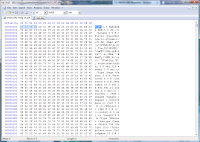
That piqued my curiosity. I embedded the same PDF file inside a Word doc twice by manually copying and pasting it into the doc as well as inserting it as an object. Firing up my trusty Hex editor, I was only able to find the magic bytes (ie. ASCII "%PDF" or hex values "25 50 44 46") for the PDF file that was embedded using the insert object method. I was not able to detect the embedded PDF file that was manually copied.


This is an interesting loophole from a hacker and forensics perspective.
That piqued my curiosity. I embedded the same PDF file inside a Word doc twice by manually copying and pasting it into the doc as well as inserting it as an object. Firing up my trusty Hex editor, I was only able to find the magic bytes (ie. ASCII "%PDF" or hex values "25 50 44 46") for the PDF file that was embedded using the insert object method. I was not able to detect the embedded PDF file that was manually copied.


This is an interesting loophole from a hacker and forensics perspective.
"An error occured in avast! engine: Invalid argument"
This annoying message popped up after I ran the update in avast! in Ubuntu yesterday. avast! crashes every time I attempt to launch it after that. Did some googling and someone suggested deleting a file called "400.vps" in the ".avast" folder. I did just that and avast! was able to launch again. However, the same error occurs immediately after the virus definition update is performed. There is an error with the signature file. Hmmmmmm. What happened to quality control nowadays?
Update: I resolved the update issue. Run the following command.
commandrine@bridge:/$ sudo sysctl -w kernel.shmmax=128000000
kernel.shmmax = 128000000
commandrine@bridge:/$
I combined this command and the avast! update command together in this script to simplify matters. You no longer need to launch the avast! GUI to start the update. Download it here.
Update: I resolved the update issue. Run the following command.
commandrine@bridge:/$ sudo sysctl -w kernel.shmmax=128000000
kernel.shmmax = 128000000
commandrine@bridge:/$
I combined this command and the avast! update command together in this script to simplify matters. You no longer need to launch the avast! GUI to start the update. Download it here.
Justified
Adobe Reader is officially the most exploited software. My decision to remove Adobe Reader from my machines years ago is now fully justified and not a choice out of paranoia. In 2nd place is Microsoft Word which is also not installed on any of my systems at home.
A case of security by obscurity? Why do soldiers wear camouflage when they can be killed by weapons of mass destruction?
A case of security by obscurity? Why do soldiers wear camouflage when they can be killed by weapons of mass destruction?
Kon-Boot
I have demonstrated password reset and cracking of Windows passwords before. I won't even bother demonstrating resetting of Mac OS X passwords because it is so trivial. Lame Apple ships a password reset utility with their Mac OS X installer DVD. DUH!!!
Kon-Boot is a powerful tool that gives you root privileges on Linux and administrator rights on Windows without needing to crack or know the admin password.
In my demo, I burnt Kon-Boot as a bootable disc and booted up my Linux system with it. Kon-Boot modifies my Linux kernel and permits me to gain root access just by entering "kon-usr". I run the "whoami" command to prove that I am logged in as root without entering the root password.
The high res version of this demo can be downloaded here.
Kon-Boot is a powerful tool that gives you root privileges on Linux and administrator rights on Windows without needing to crack or know the admin password.
In my demo, I burnt Kon-Boot as a bootable disc and booted up my Linux system with it. Kon-Boot modifies my Linux kernel and permits me to gain root access just by entering "kon-usr". I run the "whoami" command to prove that I am logged in as root without entering the root password.
The high res version of this demo can be downloaded here.
Subscribe to:
Posts (Atom)
-
This annoying message popped up after I ran the update in avast! in Ubuntu yesterday. avast! crashes every time I attempt to launch it after...
-
 I decided to install a digital certificate for my Gmail account. This is simple and free to set up. Apply for a free certificate from Comod...